AUTHOR'S NOTE · A SHORT WALK THROUGH A VERY LONG LIE
Not a manual of attack. Not a fantasy of revenge. A history of reachability.
Moscow is used here in two senses. One is the living city: apartments, kitchens, hospitals, churches, schools, jokes, rent, old women counting prices and children riding the metro. The other is the headquarters: ministries, security services, television studios, courts, archives, money, fear and the habit of sending orders outward while calling the result history.
Confuse the city with the headquarters, and power hides behind the people it uses. Separate them, and the system becomes visible.
The tone is sharp because polite imperial language has had centuries to polish itself. It can call conquest «gathering lands», censorship «protecting society», robbery «historical justice», fear «stability» and obedience «traditional values». A ministry can place a ribbon on almost any theft. A television studio can add music. A schoolbook can remove the blood and keep the dates. After enough editing, even a fire can become an architectural opinion.
So let us begin simply.
The official myth says Moscow is eternal, central, sacred, unbreakable and somehow always surrounded by enemies who mysteriously keep finding their way to its doors. The myth speaks as if geography itself bowed to the Kremlin, as if history had signed a lease, as if all roads in the East Slavic world were born wanting to end at Moscow. It is a beautiful myth, in the same way a wax fruit is beautiful. It has shape, color and confidence. It only lacks life.
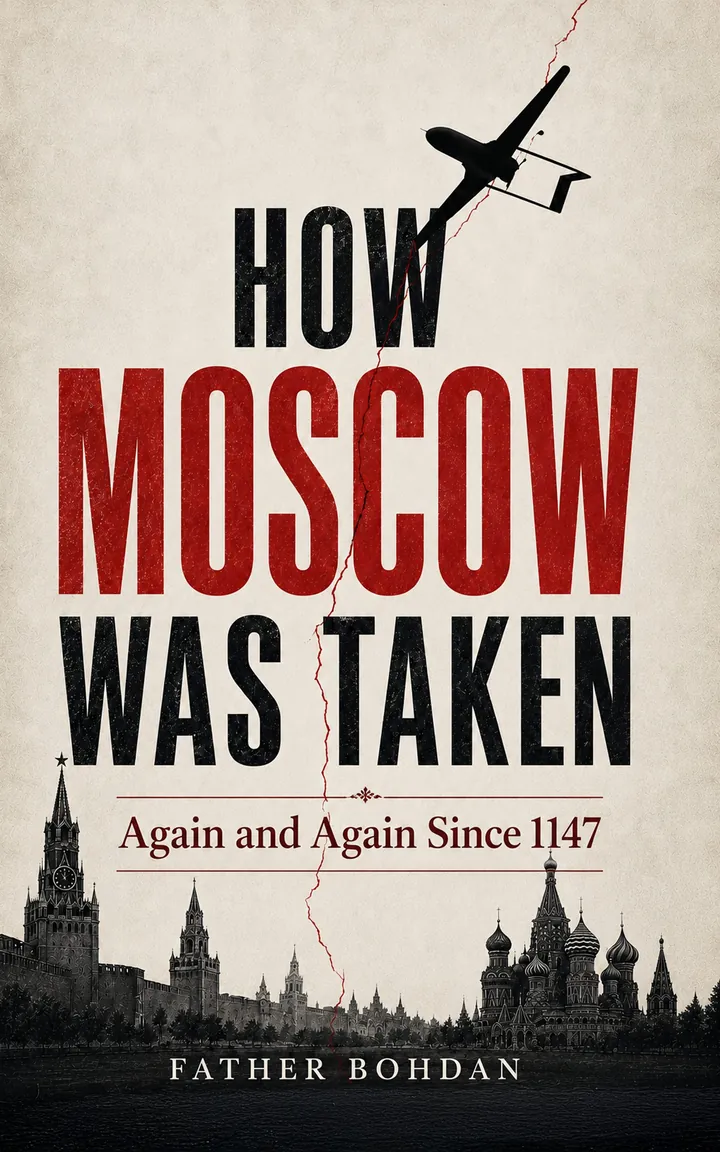
The archive says something less flattering. Moscow has been reached, entered, burned, frightened, deceived, challenged, shaken from within and then re-narrated afterward with a very straight face. The city has been touched by fire from the east, pressure from the west, raids from the south, impostors from the theater of politics, foreign garrisons, domestic revolt, revolution, panic, mutiny, poverty, memory, Ukraine and the consequences of Moscow's own orders. This does not mean Moscow is weak in the childish sense. Weak things simply break. Moscow is more interesting. Moscow survives, edits the survival and then sells the edited version as destiny.
That is the trick at the heart of the story.
A normal city admits that history happened to it. Moscow prefers to announce that whatever happened was secretly part of its greatness. Burned? A national sacrifice. Occupied? A moral lesson. Frightened? Strategic depth. Humiliated? Proof of spiritual superiority. If a French emperor enters the city, the city becomes a sacred stage. If a German teenager lands near Red Square, the incident becomes an administrative embarrassment to be filed away under «unfortunate air defense poetry». If a war sent outward begins sending smoke back toward the capital, the language changes at once. Suddenly distance matters. Suddenly civilians matter. Suddenly broken windows become civilization itself.
Of course civilians matter. They mattered before the smoke reached the center too.
The story begins with that irritation: the strange moral geography of empire. The center sends violence outward and calls it policy. The edge bleeds and becomes statistics. Then one day the return address works. Smoke rises closer to the office. The same voices that explained distant suffering with cold professionalism discover tenderness, legality, humanity and the emotional importance of airport schedules.
Smoke is a rude editor.
It crosses out adjectives. It reveals wiring. It tells the center that consequences also know how to travel.
But this story does not begin with drones, refineries or modern headlines. Those are only the newest punctuation marks in a much older sentence. To understand why Moscow can be reached, one must first understand what Moscow took.
The first great theft was not land. Land is vulgar. Anyone with soldiers can take land for a season. The more elegant theft is a name.
Can a country steal a family name? Imagine a large family after the death of a powerful ancestor. There are houses, letters, icons, debts, songs, scars, old quarrels and a trunk full of documents. Several descendants have a claim to the inheritance. Then one younger, ambitious relative arrives late, takes the trunk, changes the label and announces that he alone is the family. The others may remain alive, of course. Empires are generous in small matters. They may cook, sing, serve in the army, appear in folk costume and be loved as local color. They may not own the trunk.
That, in plain language, is the Moscow trick with Rus.
Kyiv was not a decorative preface. It was central to the early world of Rus. The medieval inheritance was wide, complicated and shared. It included lands and peoples that later moved in different directions. Moscow was not the beginning of that world. Moscow was a later north-eastern player that eventually learned a magnificent habit: take a shared inheritance, turn it into a monopoly and then accuse the other heirs of theft when they ask for the documents back.
The argument is not antique dust. Names matter most when armies carry them. A stolen name is harmless in a museum. It becomes dangerous when it arrives with artillery, police files, schoolbooks and a television map. Moscow did not merely want Kyiv as a memory. It wanted the right to explain what Kyiv meant. Ukraine is not only a neighbor in this story. Ukraine is the relative who opens the trunk and says: these papers are not yours alone.
Before Ukraine returns the manuscript, however, the path turns to an earlier humiliation for Moscow's myth: Novgorod.