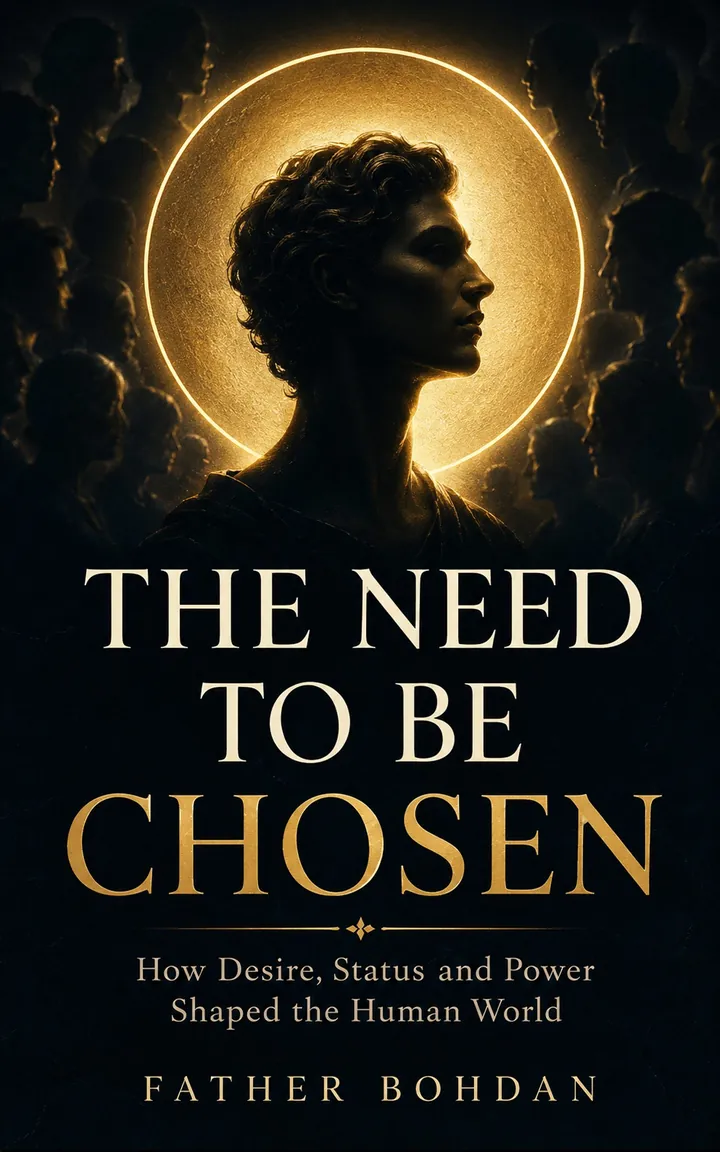
The First Mirror
There is a moment in almost every life when the world quietly changes its rules.
Nothing visible happens. No bell rings. No official arrives with a document requiring a signature. The sun rises with its usual lack of imagination, adults continue discussing money and weather, and the school corridor smells exactly as it did the day before. Yet a person who had simply been living suddenly becomes aware of being observed.
A glance lasts half a second too long. Someone laughs nearby, and for the first time the laughter seems capable of being about you. A shirt that was perfectly acceptable yesterday becomes impossible today. The body, which until then had been a practical arrangement of arms, legs and minor injuries, turns into a public statement.
This is the first mirror that matters. It is not made of glass. It is made of other people.
From then on, we do not merely enter a room. We enter it and, somewhere inside ourselves, watch ourselves entering. We hear our own voice as others might hear it. We imagine the judgement behind their eyes. Am I attractive? Ridiculous? Impressive? Weak? Too eager? Too quiet? Do I belong here? Will anyone notice me? Worse still, will everyone notice me?
The private spectator rarely leaves. It follows us through first love, examinations, job interviews, marriage, parenthood, middle age and the small diplomatic crisis caused by discovering that a younger person has called us ‘sir’. Its vocabulary changes, but the question beneath it remains remarkably stable.
Will I be chosen?
Chosen by a friend. Chosen by a lover. Chosen for the team, the university, the promotion, the marriage, the leadership, the applause. Chosen by the market. Chosen by history. Chosen by God, or at least not forgotten by Him.
We speak as though these were unrelated ambitions. Love belongs to the heart, money to the bank, power to politics, beauty to the mirror, religion to eternity. Yet beneath them often runs the same ancient current: the longing to be recognised as valuable.
Sexuality is one of the first places where this longing becomes impossible to ignore. To desire someone is to admit that another person can disturb your inner order. To want to be desired is to place part of your self-understanding inside another person’s freedom. They may look at you and feel what you hope they feel. They may also look away.
A refusal can therefore hurt far beyond the practical loss involved. A person may know perfectly well that one declined invitation is not a scientific evaluation of their entire existence. The nervous system, however, has never been famous for reading footnotes. It receives the verdict first and requests nuance later.
I have heard this question in many disguises.
A priest is often given the polished version of a life on Sunday and the unedited version at other hours. A man speaks about adultery but is really speaking about terror at becoming old. Another speaks about ambition but is still begging a dead father to notice him. A woman admired by almost everyone confesses that she has not felt seen for years. A husband demands respect, and after an hour it becomes clear that he wants permission to be tired without becoming contemptible.
No single theory explains such lives. Human motives do not queue politely. A man may build a company because he wants to protect his family, solve a problem, defeat a rival, become rich, impress strangers, employ friends and avoid wondering whether his life matters. All seven motives can be present before breakfast.
Desire is useful here as a lamp, not as a prison. It reveals how much of civilisation has been shaped by display, selection, competition, possession and the fear of exclusion. It does not claim to have invented tenderness, truth, sacrifice or prayer. A mother does not rise beside a sick child at four in the morning because she is performing for the mating market. A man may remain faithful when nobody would ever discover betrayal. A person may tell the truth precisely when truth destroys status. Human beings can act against advantage, and sometimes this is where their humanity becomes most visible. Still, the lamp shows a great deal.
The historical examples that follow are selective and inevitably shaped by the European and Christian world I know from within. Other civilisations offer parallels, contradictions and corrections that no single book can exhaust. Where pastoral scenes appear, details have been combined or altered. The human pattern matters here, not the exposure of a private life.
Humanity has carved names into stone because breath disappears. We created titles because a name alone seemed too fragile. We built ceremonies to tell the group who mattered, uniforms to make rank visible, jewellery to turn wealth into light, and stories to ensure that someone could continue entering rooms long after death. We built monuments for rulers, cathedrals for God and platforms for everyone else.
Business understands the hunger with unusual clarity. Insecurity is profitable. Entire industries survive by informing us that selection is approaching and that we are not ready. The body needs improvement. The house needs upgrading. The profile needs polishing. The child needs advantages. Even rest must be performed attractively, preferably in a place where the towels are folded into birds.
A contented human being is a commercial emergency.
Religion can resist this machinery, but religion can imitate it as well. People compete in humility, collect admiration for simplicity and construct status from the appearance of having renounced status. Vanity is an accomplished actor. Give it a cassock, a business suit, a yoga mat or a revolutionary slogan and it will know the lines by evening.