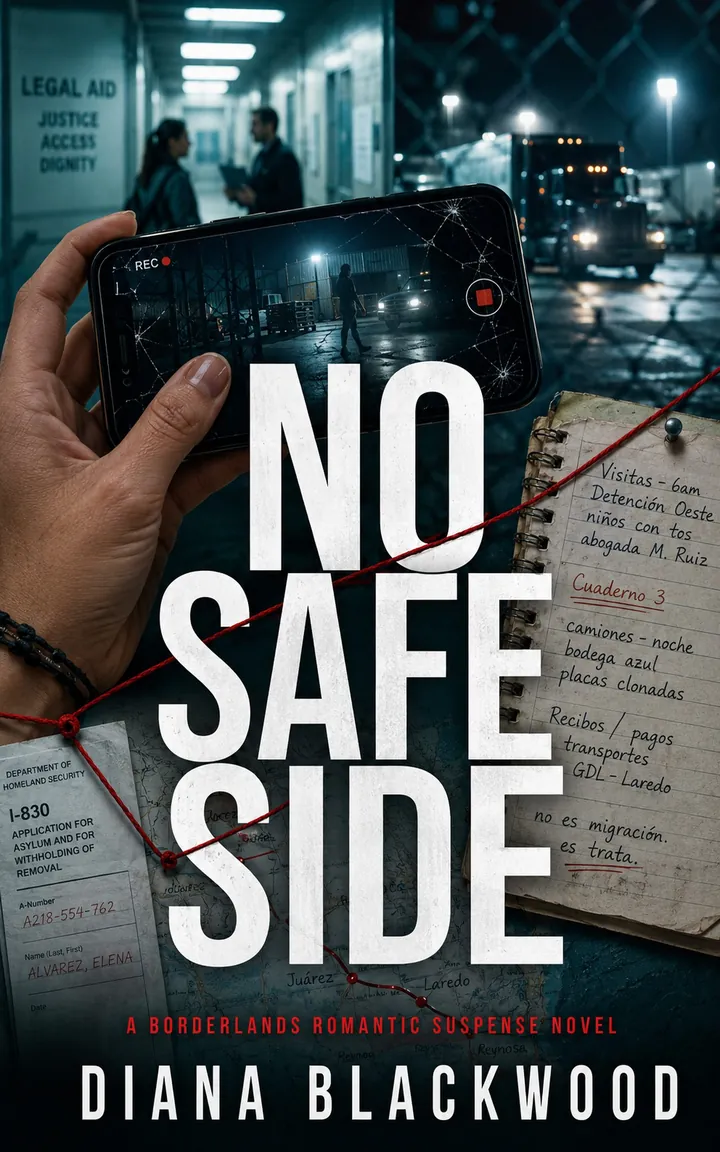
Chapter One · The Van at Dawn
The first thing Elena Alvarez noticed about the United States was that it smelled like dust, diesel, and cold metal.
Not freedom.
Not safety.
Not the clean white light her father had promised when he spoke of the other side in a voice too low for the younger children to hear.
Just dust, lifted by the tires of the Border Patrol van. Diesel from the engine coughing beneath them. Metal from the bench under her thighs, hard and chilled through the thin cotton of her skirt. The van had no windows in the back, only narrow seams of morning leaking around the rear doors, and every time the vehicle hit a rut, the whole family rose together and came down together, seven bodies trying not to touch too much because touch made fear contagious.
Mateo sat pressed against Rosa, pretending not to cry.
Luz had one hand tangled in Elena’s sleeve and the other gripping the little backpack she had refused to let go of since before dawn. Isabel held herself upright with quiet, careful dignity, as if good posture could keep a person from falling apart. Marisol kept looking at the black screen of her dead phone, thumb moving over it by habit, performing calm for an audience that was no longer there.
Camila stared at the floor.
Arturo sat nearest the doors, his shoulders squared, his face turned toward the sliver of light as if he could see a future through it.
“We did the right thing,” he said in Spanish.
No one answered.
He looked at Elena, because everyone looked at Elena when English was somewhere nearby, when papers had to be understood, when a stranger’s tone had to be judged before his words could be trusted.
“Elena,” he said. “Tell them.”
Tell them.
As if she could translate more than language. As if she could take the raw thing inside the van, the stink of fear and sweat and river mud dried on their shoes, and turn it into something acceptable at a desk. Something with clean edges. A case. A process. A family seeking protection.
Elena swallowed. Her mouth tasted of copper. “We surrendered, Papá. We asked for asylum. That matters.”
“It matters,” Arturo repeated, louder, for the others.
Rosa’s lips moved around a prayer. Her rosary was gone; she had given it to another woman two nights before, a girl barely older than Camila who had shaken so badly she could not drink water. Rosa had pressed the beads into the girl’s palm and said, “La Virgen knows where to find me.”
Now Rosa prayed with empty fingers.
The van slowed.
Everyone went still.
Through the metal wall came muffled voices, radios, the bark of an order. Doors slammed. Somewhere outside, a man laughed once, not cruelly, just because the morning belonged to him in a way it did not belong to the people inside the van.
Luz leaned closer. “Are they taking us to jail?”
“No,” Elena said.
It came too quickly.
Luz heard the lie in the speed of it. Her dark eyes lifted, enormous and dry. She was fifteen but looked younger without sleep, all angles and braids and stubborn innocence. “Then where?”
“To be processed.”
“What does that mean?”
Elena had learned the phrase from other mouths. From a volunteer in a church basement in Tijuana. From a man with a laminated card around his neck who had told them to say credible fear, family unit, persecution, extortion, threats. Words like stones in her pocket. Important, heavy, not enough to eat.
“It means they ask questions,” Elena said. “They write things down. They decide what happens next.”
“Who decides?”
The van stopped.
For one suspended second, nobody breathed.
Then the rear doors opened and morning entered like a blade.
Light struck Elena’s eyes. She blinked hard. The world outside was too wide after the van: pale sky, chain-link fencing, low buildings, men and women in green uniforms, trucks idling in rows. Beyond everything, hills rose brown and indifferent beneath the early sun.
A female agent stood at the doors, one hand on her belt.
“Step down,” she said. “One at a time.”
Elena rose first.
Her knees nearly failed when her feet hit the ground. She caught herself before anyone could see. That had become one of her private rules: collapse later, where no one needed you.
The agent looked at the group, counting. “Family?”
“Yes,” Elena said in English. “We’re a family.”
The woman’s gaze shifted to Arturo. “He speaks English?”
“A little,” Elena said. “I can translate.”
“We have interpreters.”
“I understand.”
“I didn’t ask if you understood.”
Elena felt Arturo move behind her, a protective step, useless and beloved. She lowered her eyes just enough to seem cooperative, not so much that she disappeared.
“Yes, ma’am,” she said.
The agent’s expression did not change. “Hands visible. Bags on the ground.”
They obeyed.
One by one, the Alvarez family placed their lives at their feet.
A backpack with Luz’s school notebook and two pairs of socks. A plastic grocery bag with Rosa’s medication wrapped in a dish towel. Mateo’s sweatshirt. Isabel’s envelope of baptism certificates and photocopies. Marisol’s dead phone. Camila’s cheap purse with the broken zipper. Arturo’s wallet, nearly empty, with a photograph of the family taken four years ago, before the first threats had teeth.
Elena had nothing but the documents hidden under her blouse in a flat pouch against her stomach.