1. The Receipt
The elevated train passed over Kroll's Exchange every seven minutes, and each time the ceiling trembled as if the city were deciding whether to come down.
Mila Orlov had timed it without meaning to. Seven minutes for the train. Three seconds for the lights inside the pawnshop to flicker. Half a second for Viktor Kroll to look up from the silver watch in his hand and pretend the noise had not startled him. People with power disliked being caught reacting to anything.
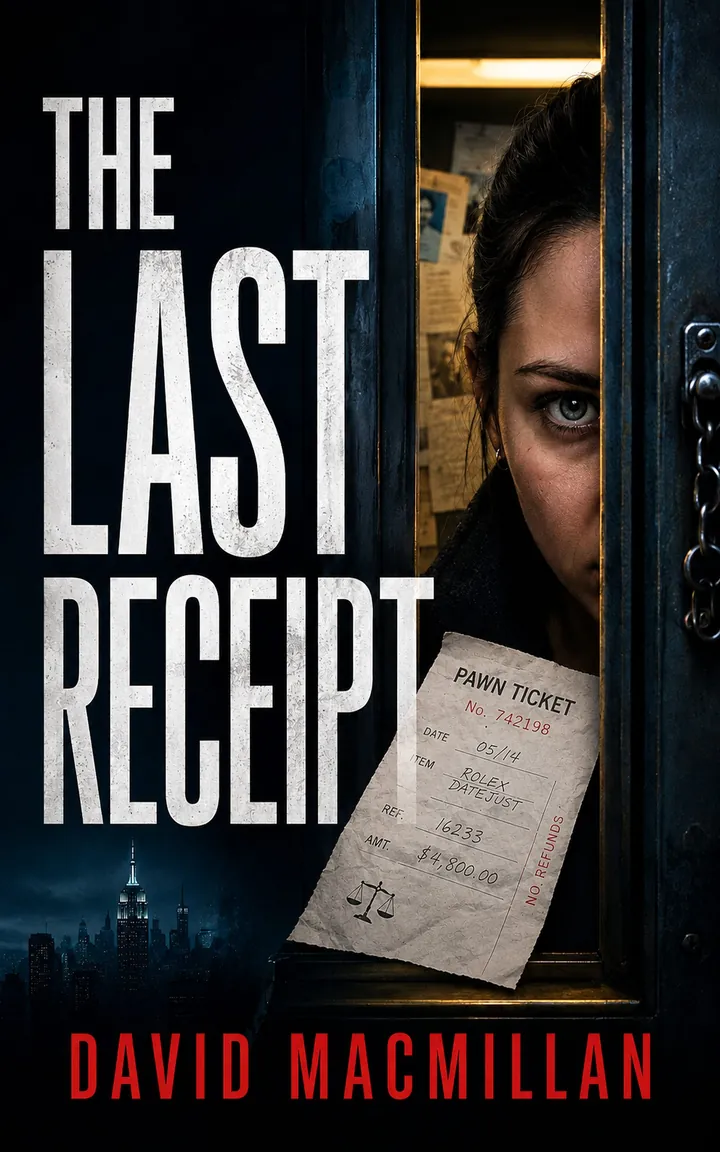
The watch lay on the black velvet pad between them. It had been her mother's only impractical possession: a narrow oval face, a scratched crystal, a band of old silver links polished thin where Nadia Orlov's wrist had worn them for twenty-six years. It did not look expensive in the way New York understood the word. It looked kept.
Kroll turned it over with a jeweler's loupe pinched in one eye. His fingers were thick, yellowed around the nails, careful in a way that was almost tender. Mila hated that. She could have forgiven clumsiness. Clumsiness would have suggested he did not know exactly what he was touching.
"Twenty dollars," he said.
Mila did not move. Her bag strap cut into the soft place between her shoulder and collarbone. Inside the bag, folded twice and hidden inside her forensic assessment textbook, was the email she had printed at the library because she could not afford to let it exist only on a screen. Aster University Office of Student Accounts. Outstanding balance. Immediate action required. The words had weight. They had followed her from Queens to the train to this narrow shop under the tracks, where old guitars hung from the wall like skinned animals and wedding rings slept in rows beneath glass.
"It is silver," she said.
"Silver-colored."
"It is silver."
Kroll smiled, not with his mouth but with the skin under his eyes. "Little bit. Not much. Sentiment, yes. Metal, no."
Behind him, a handwritten sign warned that all sales were final, all loans subject to fee, all claims requiring original ticket. The fluorescents made everything look recently ill.
"Forty," Mila said.
Kroll set the watch down as if laying a child in a coffin. "You want to sell or pawn?"
"Pawn."
"Then twenty."
"If I sell?"
"Twenty-five."
The second train came. The ceiling buzzed. Somewhere in the back room a man coughed once, then went quiet. Owen, Kroll's nephew, if the greasy little nameplate near the register was honest.
"It works," Mila said.
"So does the clock on my microwave. I do not lend against miracles." Kroll leaned back on his stool. His shirt strained at the buttons. A gold chain vanished into the gray hair at his throat. "You have other things, Mila."
Her name in his mouth changed the temperature of the room.
She had given it to him the first time because the form required a legal name, a current address, a phone number, a signature beneath language that made desperation sound voluntary. She had not understood then that every blank she filled became a door he could open later.
"The watch," she said. "Only the watch today."
"Today." He tapped the glass with one finger. "You said that last time with the camera."
Before the watch had come the camera, two textbooks, and the small gold ring Nadia had pressed into her palm at the airport and called insurance, laughing because neither of them had wanted to say emergency.
Kroll opened a ledger the color of dried blood. He still used paper for some transactions, though a computer sat beside the register with a cracked keyboard and a strip of tape over the webcam.
"You are late on the camera fee," he said.
"I have until Friday."
"Friday was yesterday in my records."
"Today is Thursday."
He looked at the wall calendar. It was from last month. The woman in the picture wore a red swimsuit and an expression of permanent surprise. "In my records," he repeated, "Friday was yesterday."
Mila swallowed. Hunger made an animal sound inside her, soft but humiliating. Pride, she had learned, did not need large conditions in which to suffer. It could suffer over fruit.
"I can pay the fee tomorrow," she said.
"Tomorrow is popular. Everybody brings me tomorrow." Kroll wrote something in the ledger. His pen was silver, too fine for him. "Twenty for the watch. Minus the late fee."
"No." The word came out too quickly.
He paused.
Mila forced her hands to remain still on the counter. She had spent years training herself not to show panic. Panic invited management. Panic made people lower their voices and slow their speech and look for the nearest authority. Panic, on a scholarship student with an accent, became evidence.
"I need cash," she said carefully. "Not a bookkeeping adjustment."
"Everyone needs cash." Kroll looked past her, through the rain-striped front window. The street outside was a running smear of brake lights, umbrellas, steam from a cart selling coffee burnt black before eight. "Pretty girls especially. But pretty girls always find ways to pay."
Mila's first thought was absurdly academic: boundary test disguised as joke. Her second was older and colder: do not give him the satisfaction of seeing where it landed.
"Thirty," she said.
Kroll laughed once. "You negotiate like professor."
"Twenty-eight."
"Twenty-two."
"Twenty-five and you write Friday as Friday."
He studied her. She kept her face attentive, almost polite. This was a skill too, though Aster did not award credit for it: letting a man believe he was deciding whether to be generous while you calculated how little of yourself could be spent.