Prologue · Morning After the Storm
At first there was only white.
It was not the white of a page or a ceiling or morning light through curtains, though some broken part of my mind tried to make it into those gentler things. It was bigger than that. It had weight. It pressed against my cheek, packed itself into my collar, filled the cracks between my gloves and sleeves. I did not wake so much as return by inches to the fact of my body.
Cold came first.
Pain came later, as if it had been waiting its turn.
I remember trying to move my right hand and feeling nothing answer. For several long seconds I believed the hand was gone. Then a dull pulse began somewhere beneath the glove, a slow, stupid knocking, and I understood that it was still attached to me. That seemed important. I held to it with the seriousness of prayer.
My mouth tasted of blood and fuel and old wood.
The world made no sound.
That was the first wrong thing I understood clearly. Not the cold, not the blood, not the difficulty of breathing. Silence. At Old Bering Camp there had always been some machine asserting our claim on the place: the generator coughing behind its shed, dogs striking their chains against frozen posts, men chopping, hauling, cursing, radios breaking apart and coming back together in the same nervous breath. Even at night the camp had never been quiet. It had hummed and ticked and burned. It had made the noises human beings make when they want the dark to know they have not surrendered.
Now there was nothing.
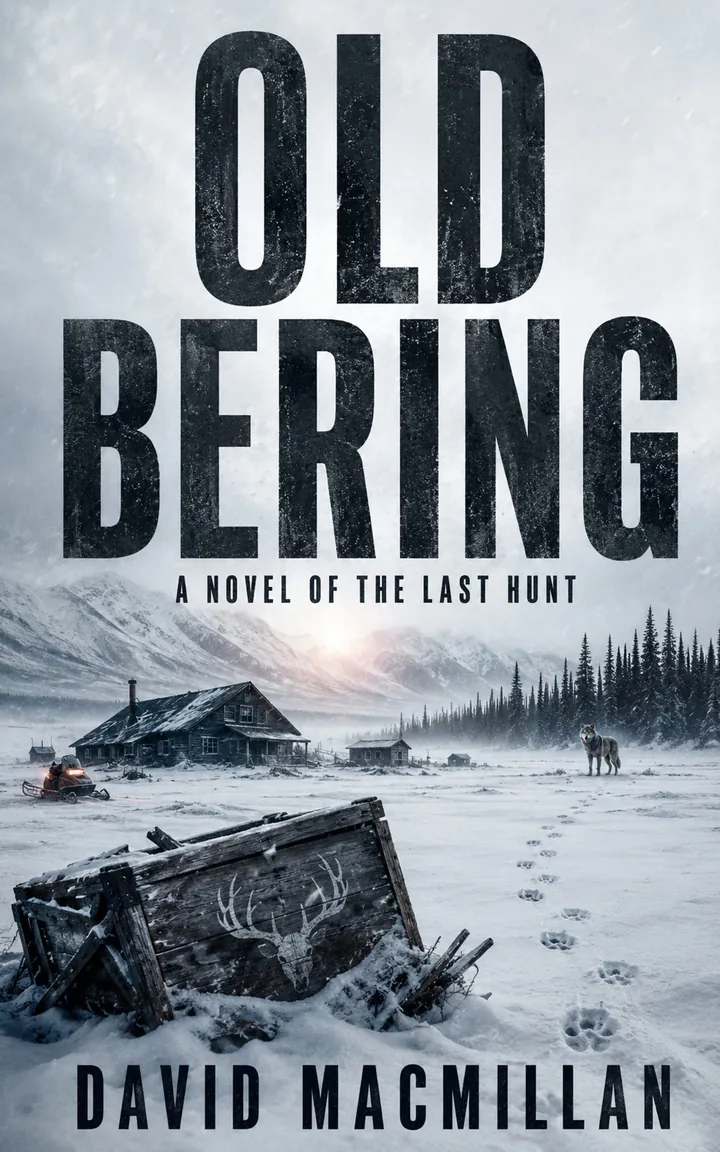
I opened my eyes fully and found that I was lying beside a crate.
It had been built for an animal that was supposed to become property. Heavy pine boards. Iron strapping. A stenciled inventory number half-erased by snow. One side had burst open and the lining hung out in strips, dark with melt and blood or oil. The lid lay several feet away, split along its grain. Bent screws stuck out of the wood like old teeth.
At the time I did not think: trophy crate. I did not think: this was meant for him.
I thought only that its broken side had made a shallow cave in the drift, and that I was alive because the wind had packed snow around it instead of over my face.
I tried again to move. My ribs answered with a clean white flare that took the world away for a moment. When it came back, I was looking toward the camp.
It lay below me in the basin, small and dark and wrong. Snow had softened the lodge roof and erased the paths between buildings. One cabin door stood open. The radio mast leaned at a drunken angle, its guy wires lost beneath ice glaze. A snowmachine had been driven nose-first into a drift and left there, its orange cowling showing like a wound in the morning. No smoke rose from the stovepipes. No one came out.
The North had not destroyed the place grandly. That would have been easier to understand. It had simply removed the motion from it.
A strip of flagging tape on a spruce branch snapped once in the wind.
I listened for dogs.
Nothing.
I think that was when fear entered me properly. Before that I had been occupied by the animal business of survival, the body taking inventory with no interest in meaning. But the absence of the dogs reached some deeper chamber. Tessa's dogs had never allowed silence. They had barked at ravens, at engines, at weather, at the scent of a man walking too close with meat on his gloves. They had complained against the whole white world with bright, living outrage.
Now they gave no answer.
I got my left elbow under me. Snow slid from my coat. The effort made something shift inside my chest and I lay still until the nausea passed. My camera was gone. My field bag was gone. One boot was packed so hard with snow I could no longer feel my toes.
I remember thinking that I needed to stand.
I also remember understanding that I would not.
The spruce line rose beyond the camp, black and patient against the white slope. For a long time I watched it without knowing what I was looking for. My vision blurred and cleared. The trees seemed to draw nearer and then retreat, as if the world were breathing.
Then he came out.
Not from nowhere. That matters. Nothing about him was miraculous. He stepped between two black spruce at the edge of the open ground, placing his feet with the tired economy of an old animal. Grey, not white. Tall through the shoulder, lean along the flanks, with a darker saddle running over his back. Snow clung to the fur along his legs. One ear showed a torn notch. His head was low at first, nose working the air, and then he lifted it and looked across the basin.
At me.
Old Bering was smaller than fear had made him and larger than any photograph could have held. He was not monstrous. That was the terrible part. He stood there as an animal stands when it has survived more winters than most living things around it, without drama, without apology, without the slightest need to explain itself.
I had seen men look at death with less calm.