Chapter 1 · The Crate That Breathed
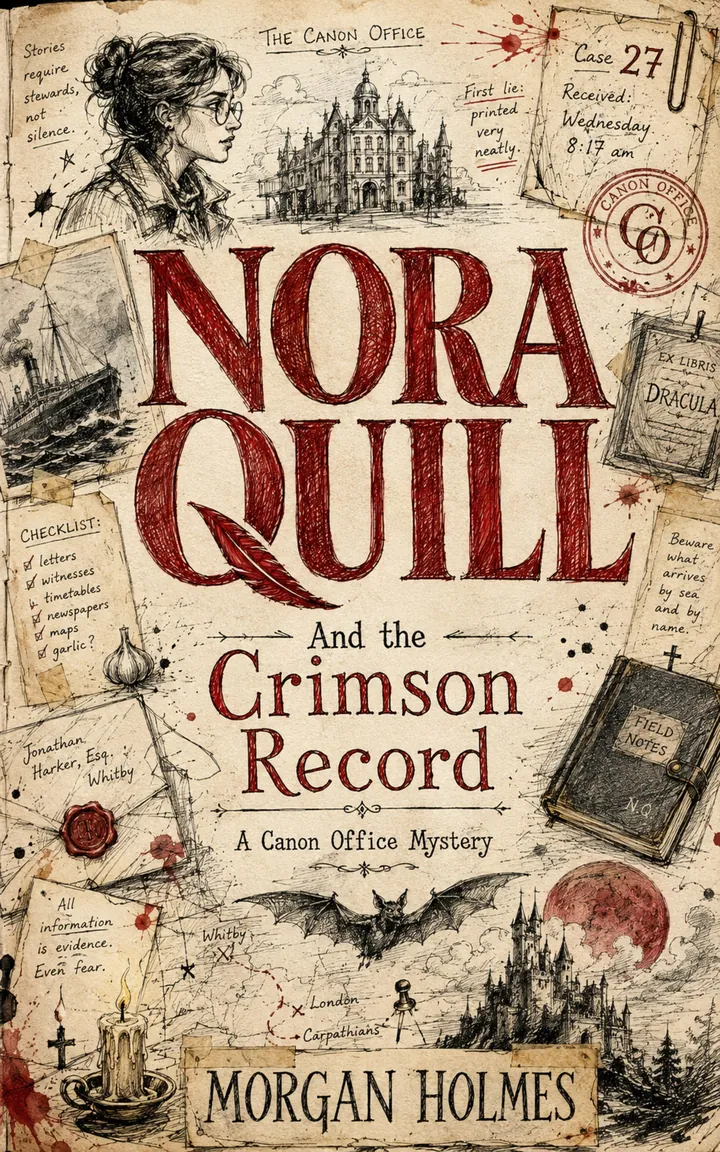
The crate arrived at The Canon Office at 8:17 on a Wednesday morning, which was rude of it. Nothing with iron bands, cemetery earth, and an active damp smell had any business arriving before coffee.
Nora Quill was in Room 12B trying to persuade a pile of post-Frankenstein exposure forms that they had, in fact, been filed already. The forms disagreed by multiplying whenever she looked away. This was not unusual. The Office believed in paperwork the way certain saints had believed in hair shirts: as proof that suffering could be organized.
She had just written See prior packet, for the love of all reasonable indexing in the margin of a form labeled Residual Lightning: Personal Effects, when the floor gave a soft, nautical heave.
Her pencil rolled off the desk.
Across the room, Mabel Finch caught it without looking up. Mabel was perched on a stool with a stack of witness appendices balanced on one knee, three pencils in her sleeve, and a length of red thread between her teeth. "Either the building has indigestion," she said around the thread, "or Pym has opened a sea door again."
"Sea doors should knock," Nora said.
"Sea doors consider knocking bourgeois."
The brass speaking tube beside the door coughed. It produced a gust of cold fog, one dead leaf, and Mr Bartholomew Pym's mild voice.
"Room 12B, if you would be so good. Freight has arrived at the west receiving table. Possibly from a ship. Possibly from a grave. Possibly both, though I dislike judging cargo by smell."
Nora and Mabel exchanged the kind of glance that, in Room 12B, counted as a signed waiver.
"That is your assignment voice," Mabel said.
"That is his someone-is-about-to-ask-me-to-sign-for-a-curse voice."
"Your names are on the routing slip," Pym added from the tube. "Mrs Pembroke requests you not touch anything that appears to breathe unless it does so in writing."
Mabel removed the thread from her mouth. "Sensibly narrow instruction."
Nora grabbed her satchel. It contained two notebooks, a fountain pen, a thermos of tea, a packet of emergency biscuits, a Victorian phrasebook still singed from a previous misunderstanding, and one small brass Office pin which had never sat straight on any article of clothing in her life. She checked the pin anyway. It tilted loyally toward disaster.
Since the Frankenstein case, the pin had developed a habit of warming before bad news and cooling after Nora had already made the mistake. This seemed less like magic than institutional commentary. She had spent the last three weeks telling herself that she had learned restraint, proportion, and the difference between witnessing a wound and trying to fix a book until it no longer hurt. The Office had rewarded this growth by giving her seventeen duplicate forms and one chair that sighed when she sat down.
Still, the forms had been almost comforting. Residual lightning, misfiled creature testimony, a dispute over whether a laboratory assistant's umbrella had acquired moral agency: ordinary aftermath. Difficult, yes. Haunted around the edges, certainly. But familiar enough that Nora could pretend she was becoming competent.
The floor heaved again.
The pretense rolled under the desk with her pencil.
The west receiving table stood in a part of the Office that did not appear on the public map because the public map was a lie and, more importantly, because the west receiving table moved whenever Logistics felt underappreciated. To reach it, Nora and Mabel followed Pym's chalk arrows through three corridors, down half a staircase, across a landing where a portrait of Louisa May Alcott was arguing quietly with a taxidermied raven, and into a long room lit by lamps with green glass shades.
The crate sat in the center of the receiving table.
It was long, rectangular, and built of dark planks swollen with salt. Iron bands crossed it like ribs. A shipping label had been nailed to the lid with an old square-headed nail, and damp grave earth had leaked from one corner onto the polished wood of the table in a tidy little heap. The whole thing smelled of sea fog, garlic, ink, and something lower than dirt.
Three smaller tags hung from the iron bands. One was a shipping chit stamped with a port Nora did not recognize until the letters shifted and became WHITBY. One was a customs declaration that listed the contents as printed matter, private soil, and regrettable implications. The third was blank except for a smear of burgundy wax.
Nora did not touch the wax. She had learned several professional lessons since joining the Office, and one of them was that any seal too tasteful to explain itself should be treated as a threat with stationery privileges.
The receiving table had begun to react to the crate. Its polished surface darkened around the leaked earth, not stained exactly, but remembering damp cellars, ship holds, and rooms where no one had asked permission before entering. A faint line of red thread, one of Mabel's witness anchors, crawled from her sleeve toward the crate and then stopped, quivering.
A drip fell from the iron band to the floor.
Water would have been kinder. This was the memory of water kept too long inside wood with a passenger that had forgotten air. The drop struck the tile and spread into a tiny map of a coastline Nora had not learned yet. One black inlet opened like a mouth before the tile dried clean.